

GLOBAL > Obstacle Management
Obstacle Management
Securing Airports Against Obstacles: Strategies and Best Practices

Obstacle management is one of the major constraints faced by airport operators. Often perceived as complex and imposed, it is nevertheless far from inevitable. When addressed with method, anticipation and a good understanding of the regulatory framework, it can be managed in a simple, efficient and sustainable way.
Through this article, we present the key challenges related to securing airports against obstacles, as well as the strategies and best practices implemented by CGX AERO on real-world projects. Regulatory constraints are illustrated through work carried out by our teams, showing how a structured approach can transform an obligation into a genuine lever for safety and planning.
Safety, regulation and planning: the challenges faced by airports
Safety at the heart of operations
Airport operators deal daily with complex challenges: ensuring flight safety, maintaining regulatory compliance and anticipating development around their infrastructures. Their role goes far beyond accommodating aircraft; it primarily involves protecting every flight path and maintaining safe conditions for take-off and landing, while taking into account the evolution of the surrounding territory.
In this context, airports must operate within two complementary approaches:
-
Corrective, when managing existing obstacles and adapting operations or infrastructure accordingly.
-
Preventive, by anticipating the evolution of obstacles, whether due to vegetation growth or construction projects driven by local authorities.
This dual approach highlights the complexity of obstacle management: both reactive to existing conditions and proactive in preparing for the future.
Keys to informed decision-making
To achieve these objectives, airport operators need reliable and clear solutions to quickly identify obstacles, assess the risks associated with their presence and minimise the impact of urban development around the airport, while complying with ICAO Annex 14 requirements and national regulations. These challenges vary depending on the size and role of the airport:
-
At small regional airports, these activities are often constrained by limited resources.
-
At large international hubs, they are made more complex by the need to coordinate with multiple stakeholders, including airlines, local authorities and developers.
Managing risks and securing the future
Effective obstacle environment management brings tangible benefits. Reducing the presence of hazardous obstacles strengthens flight safety and user confidence, while accurate aeronautical obstacle surveys, combined with appropriate analysis, facilitate airport-area planning and discussions with local authorities. Understanding and applying ICAO rules becomes a smoother process, helping to secure investments and anticipate future developments.
Some airports go even further by integrating a forward-looking dimension into their studies. In Lyon, for example, obstacle limitation surfaces were calculated not only for existing runways but also for a potential third runway. Although this infrastructure does not exist today, the airport chose to anticipate this scenario in order to preserve future development margins. This approach perfectly illustrates the strategic value of preventive obstacle management: it helps prevent surrounding urbanisation from compromising future projects.
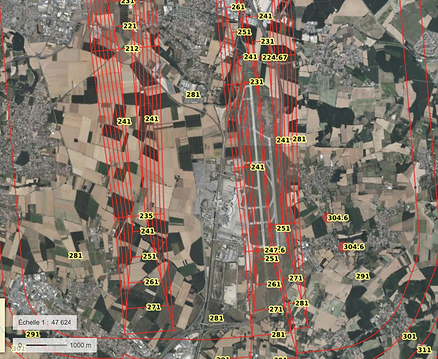
OLS constraint map of Lyon Saint-Exupéry Airport with provision for a new runway
Challenges to overcome
Despite these benefits, challenges remain. Preserving OLS can make compliance difficult to maintain without specialized expertise. Urban development around airports often creates tensions between safety requirements and local economic development.
In some cases, real estate or commercial projects led by municipalities directly conflict with aeronautical protection surfaces. The construction of buildings or business zones can compromise flight path safety, forcing airport operators to react late, often in a tense negotiation environment with local stakeholders.
Additional internal constraints further complicate matters. Limited resources frequently require operators to prioritise between competing projects, while available technical tools may not always be easily accessible. As a result, communication with external partners becomes more complex, and obstacle management turns into a delicate exercise.
If not anticipated, these obstacles can lead to operational restrictions, additional costs and even avoidable incidents.
Expertise connecting field operations, regulation and anticipation
A comprehensive approach to obstacle management
At CGX AERO, we support airport operators in mastering their obstacle environment, from immediate diagnostics to long-term planning. Our expertise covers both corrective actions, essential to ensure compliance and operational safety, and preventive approaches, which are key to anticipating territorial changes and preserving the future development of airport platforms.
For short-term and corrective actions, our teams carry out accurate and reliable obstacle surveys. These surveys enable the establishment of obstacle penetration diagnostics, identifying non-compliant situations and their potential impact on safety.
We then support operators in implementing corrective action plans, which may include the installation of PAPI systems, the definition of obstacle lighting appropriate to the situation, or runway reconfiguration where no other solution is feasible. The objective is clear: to rapidly restore an optimal and well-documented level of safety.
In the medium term, as a first preventive step, CGX AERO helps airports anticipate future risks through comprehensive digital modelling of their environment. We do not limit our analysis to identifying current penetrations; we also highlight obstacles that are close to penetrating protected surfaces. This ability to quantify remaining safety margins allows operators to make informed decisions before an obstacle becomes an operational constraint and to implement appropriate actions.

Specific mapping of nearly penetrating area against OLS (less than 2m)
In the long term, this forward-looking analysis goes beyond safety considerations and becomes a true planning tool. Based on these models, CGX AERO develops Safeguarding Maps that provide a clear view of areas where urban development remains compatible with aviation safety. These maps become a valuable communication tool between airports and local authorities, fostering sustainable coexistence between aviation infrastructure and land-use planning.
These combined approaches — corrective and preventive — provide operators with a comprehensive understanding of their environment and transform obstacle constraints into a controlled parameter. By shifting from a reactive to a global approach, airports gain in safety, visibility and decision-making capability.
Creating value through anticipation
By giving meaning to data and providing visibility on safety margins, CGX AERO helps operators turn regulatory constraints into strategic levers and establish a true culture of anticipation.
Anticipation then becomes a performance factor: fewer incident risks, fewer unforeseen costs and a stronger ability to plan airport developments. By combining technical expertise, regulatory mastery and proven modelling tools, CGX AERO enables airport operators to manage the safety of their operations with confidence.
Solutions designed for airport operators
To address the concrete challenges discussed above — regulatory complexity, urban development pressure and budget constraints — CGX AERO provides tools and services tailored to the needs of airport operators:
-
Accurate and up-to-date data to support strategic and operational decision-making. This digital twin enables work on a comprehensive environment surrounding the airport and allows simulation of various development scenarios, whether related to the airport itself or its surroundings.

Digital Surface Model of Aurillac and its surroundings
-
Visualisation and analysis solutions that facilitate communication between technical teams, authorities and external partners. Safeguarding Maps in particular help non-specialists understand aeronautical constraints while providing clear and precise information on construction height limits.

Safeguarding map of Bordeaux complying with OLS constraints and radio-electrical restricted surfaces
-
Recognized expertise to translate regulatory requirements into clear, measurable and effective actions. Corrective action plans can be transformed into targeted interventions, such as those illustrated in the example below, where only penalizing trees (shown in red) are addressed, instead of applying systematic clearance measures as might otherwise occur.

Forest harvesting plan in accordance with OLS constraints
Our mission is simple: to enable airport operators to retain control of their environment — today and tomorrow.
With the forthcoming update of ICAO Annex 14 and the introduction of OES and OFS surfaces, airport operators will need to adapt their obstacle management practices. This regulatory evolution requires a comprehensive review of existing obstacle assessments and a more global understanding of the aeronautical environment.
Targeted corrective actions — such as obstacle surveys providing high-quality data — make it possible to quickly restore compliance and operational safety.

New OES / OFS surfaces of the future ICAO Annex 14
In parallel, preventive approaches based on environmental modelling, the assessment of remaining safety margins and the development of safeguarding maps provide operators with essential forward-looking capabilities.
By combining these two approaches, obstacle management moves beyond a regulatory constraint to become a genuine management tool, supporting flight safety, operational performance and the long-term planning of airport platforms.